Field Notes · June 14, 2026 · 4 min read
Floodlight
I built a hat in Hot Springs before I understood what any of it meant. The meaning showed up later, on the road.
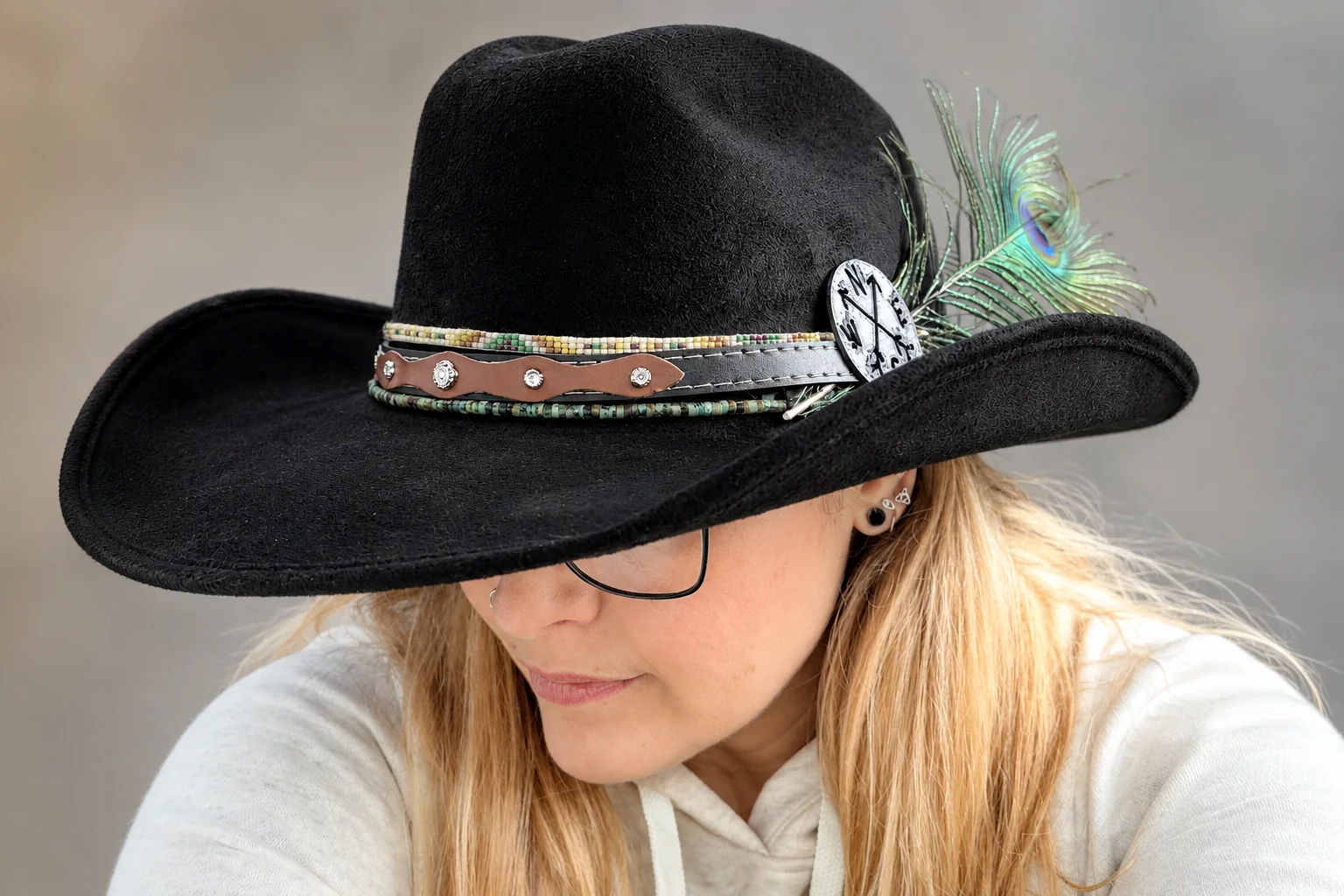
There is a place in Hot Springs, Arkansas called Podunk Annie’s with a hat bar in it, which is exactly what it sounds like. You pick a body, and then you build.
I picked black felt. Then a compass. Then bands in green and earth tones, a leather band, some metal on it, and a peacock feather.
I did not have a theory. I was standing at a counter at the start of a long drive, picking things because they looked right, in the way you pick things when nobody is watching and there is no deliverable at the end.
The meaning showed up two states later.
Somewhere on that drive I worked out what I had actually made. Black, because the job is to listen before labeling. The compass, because I needed orientation and not a destination, which are different things and I had been confusing them for years. The peacock feather, because I have spent a lot of my professional life being useful quietly, and I was about to go be visible on purpose, and I wanted something on my head that did not apologize for it.
None of that was available to me at the counter. It required about four hundred miles.
I have been listening to a lot of Alan Watts in the car, which is either the most or the least original thing a person can do on a road trip. The idea of his that keeps working on me is the one about two kinds of attention.
There is the narrow beam. The spotlight. It is the mode where you fix on one thing with everything you have, and the thing becomes very sharp, and everything around it goes dark. It is enormously useful. It is how anything gets finished.
And then there is the wide one. Floodlight. The peripheral, unfocused, taking-it-all-in mode, where nothing is sharp but you can see the whole field and how the pieces sit against each other.
Watts’s point, or the part I keep chewing on, is that the spotlight lies to us about the nature of things. When you fix hard on one object, it appears to be a separate object. Figure without ground. But the thing and its surroundings came into being together, the way a crest cannot exist without the trough on either side of it. You cannot have a front without a back. The separation is an artifact of how we are looking, not a property of what is there.
Here is why this is not an abstraction for me.
My day job runs entirely on spotlight. Deadlines, deliverables, one problem at a time, resolved and closed. I am good at it. It has paid for most of my life. And it has trained me, over about twenty years, to walk into a room already knowing what I am there to extract.
That instinct is fatal to this book.
If I sit down across from someone in spotlight mode, I will find exactly what I came for and nothing else. I will get my quote. I will hit my beat. And I will drive away having confirmed a shape I brought with me, which is the opposite of documentary work and closer to shopping.
The interviews that have gone well have all had the same quality, and it is not that I asked better questions. It is that I arrived diffuse. Nothing sharp. Nobody in particular being looked for. Two hours of conversation that goes nowhere useful, and then somewhere in the third hour a person says the thing sideways, in the middle of a sentence about something else, and it is the whole chapter.
You cannot get there in narrow beam. The narrow beam would have cut the first two hours.
What I have slowly figured out is that I do not know how to switch modes on command. I have tried. Sitting still and deciding to be receptive mostly produces a person sitting still, being tense about receptivity.
What works is the drive. Six hours of highway with nothing to solve. The mode changes on its own somewhere around hour three, and by the time I get where I am going I am a different kind of attentive than the person who left the house.
Which is inconvenient, because the drive looks like the wasted part. It is the part that has no output. If you were auditing my calendar you would circle it.
I have started to think it is not the commute. It is the equipment.
I do not have advice about this. I have a suspicion, which is that most of us are running almost entirely on narrow beam now, and that the parts of our lives that used to widen it, the drive, the walk, the long stretch of being unreachable, have been colonized one by one by something with a notification on it. We did not decide to give up the floodlight. We just filled in all the places it used to live.
The hat is on the passenger seat most days. I still do not think I picked any of it on purpose.
Resonance: The Quiet Revolution of Compassion is out November 10, 2026 from Akiiki Press.