Field Notes · July 7, 2026 · 4 min read
Two Hundred Dollars and a Detour Through Germany
Nobody tells you that a meaningful share of writing a book is customs paperwork.
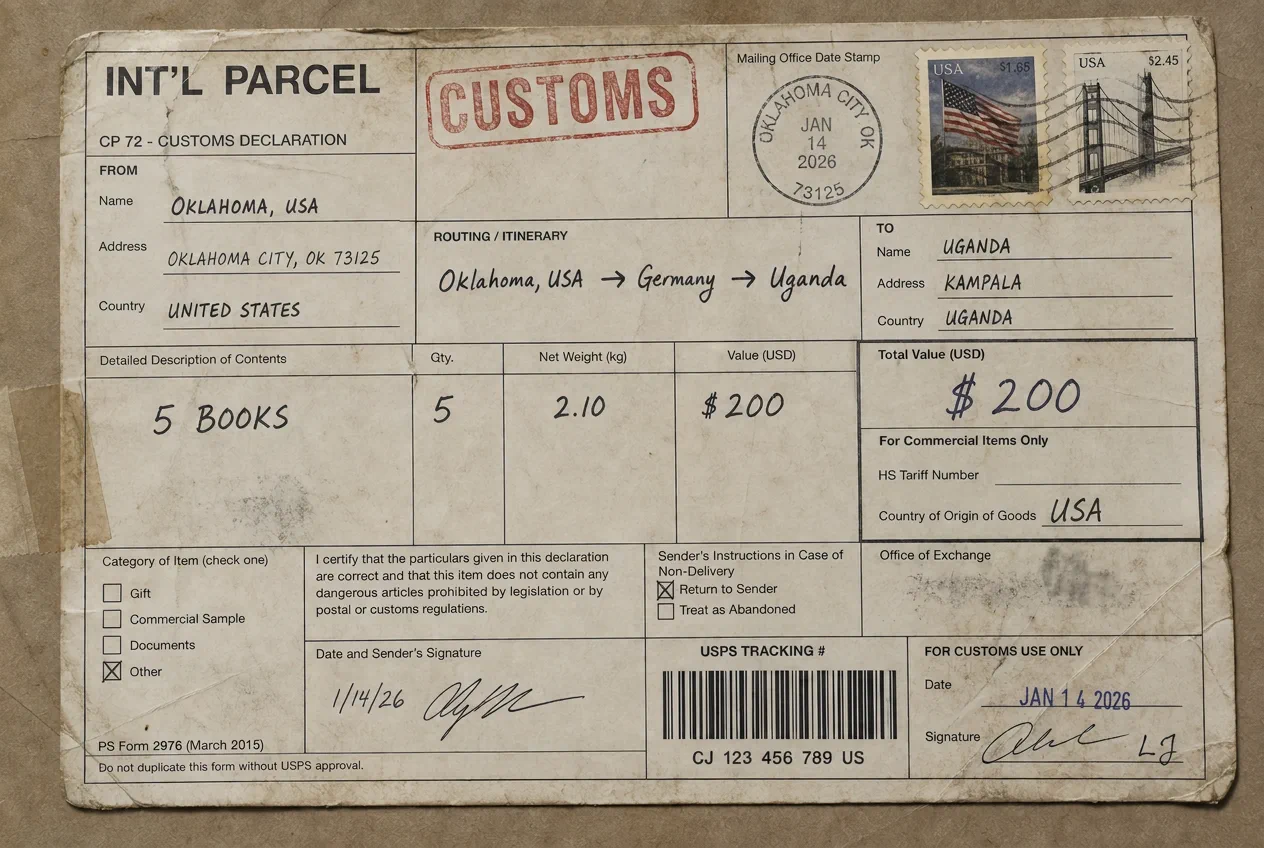
Nobody tells you that a meaningful share of writing a book is customs paperwork.
It cost about two hundred dollars and took two months to get five copies of my first book to the colleagues in Uganda whose work is in it.
Five. Not a pallet. Five books, which went out from Oklahoma and, for reasons I still cannot fully reconstruct, routed through Germany, sat in customs, and arrived long after I had stopped refreshing the tracking page.
That is the part of authorship nobody puts in the montage.
I want to write about this because I think the polished version does real damage. In the polished version, a writer has an idea, and then there is a shot of them looking thoughtfully out a window, and then there is a book. Every step between those is compressed into a jump cut. And people who might otherwise write something look at that and conclude the gap between them and it is talent, when a lot of the time the gap is just tolerance for administrative grind.
So here is the actual ledger.
I have a full time job. It is in communications, it is demanding, and it is where the money comes from. The book happens at night and on weekends and in the two hours before anyone else is awake. There is no sabbatical. There was never a version of this where I quit and went to a cabin.
I run my own imprint, which sounds impressive and mostly means I am the one who bought the block of ISBNs and has to remember which unassigned number goes with which format. Paperback gets its own. Hardcover gets its own. Ebook gets its own. If you assign the wrong one you find out from a retailer six weeks later.
I am also the person chasing files. The editor's markup, the designer's cover comps, the formatter's interior proofs, all moving between three people on three schedules, all named with dates so I can tell V3 from V3 revised from V3 revised final. I have a naming convention because I once lost a day to not having one.
Then there is the part that is not paperwork and is much harder.
Every person in this book reads their own chapter before it goes anywhere. All of them. That means writing a chapter, sending it, waiting, sometimes waiting a long time, receiving corrections, applying exactly those corrections and nothing else, and sending it back. Some chapters are on their fourth version. One is on its seventh.
This is slow and it is expensive in time and it is not optional, and I would not change it. But I want to be plain that it is the single biggest reason this book has taken as long as it has. The ethics have a schedule cost. You do not get to have the practice and also have the fast version.
And then there is the marketing, which arrived as a genuine shock.
I had a picture in my head where you finish the book and hand it to someone whose job is the rest. What actually happened is that I researched podcast booking platforms, press request services, award submission deadlines, review copy distribution, and self serve billboard companies, and built a spreadsheet, and made a series of decisions about where a limited budget goes. I got turned down by a publicist. That happens. It goes in the ledger too.
None of this is a complaint. I chose all of it, including the parts that cost me most, and I would choose them again.
But I notice something when I sit with the people in this book, almost all of whom are also running something. The scholarship woman in Texas has been mailing checks by hand for twenty five years out of her own house, using her own address and her own postage, and the whole operation lives in plastic tubs of manila folders. The man with the animal sanctuary is up every three hours through baby season and does his own accounting. The event in Oklahoma runs on borrowed gymnasium space and donated chili.
Not one of them has an operations department. All of them have the tubs.
I used to think of the tubs as the unglamorous part, the tax you pay for the meaningful part. I have started to think that is backwards. The tubs are the evidence. Anybody can care about something. The tubs are what it looks like when somebody kept caring on a Tuesday in February when nobody was watching and there was nothing in it.
The five books made it to Uganda eventually. They are in an office there now. Two hundred dollars, two months, and a country neither of us had anything to do with.
Worth it. Also, still annoying. Both of those are true.
Resonance: The Quiet Revolution of Compassion is out November 10, 2026 from Akiiki Press.